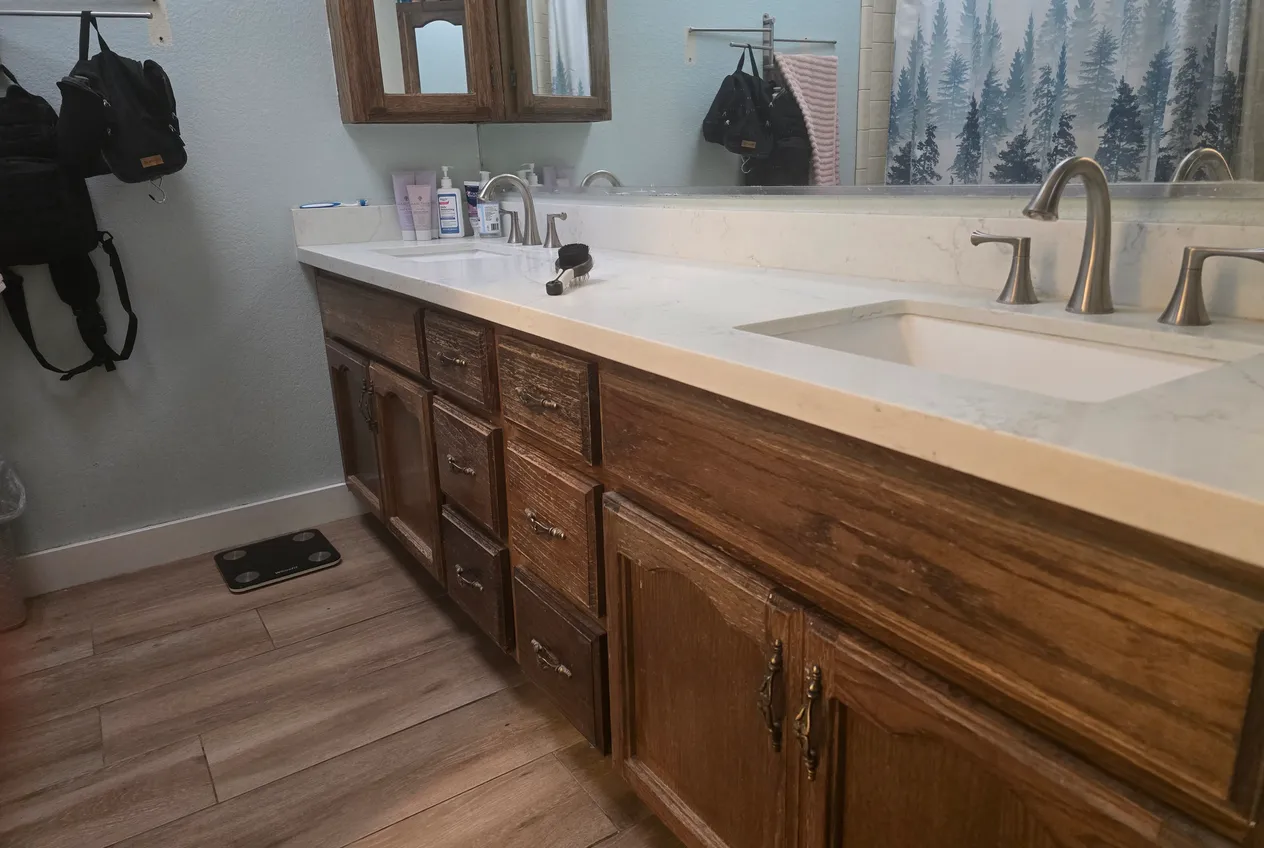
Snap a few photos of your space and the products you love. We build an itemized estimate from your rooms and your actual prices.
No spreadsheets, and no waiting three weeks for a bid just to learn the rough number.
A few shots of each room. The Engine reads the existing conditions and lays out every material line by line.
Found the perfect tile or faucet? Snap its price tag and we put that price straight onto the line.
Not a vague range that leaves you anxious. A line-item estimate you can adjust before you spend a dollar.
Your photos and estimate are yours to revisit for 30 days. Download the PDF to keep it forever.
Your estimate is not a locked number. Every line item begins at the average cost for your area and your scope, and then you correct it: the real price of the flooring you picked, the rate a contractor actually quoted you, the tile you already found on sale. Change a line and the total moves with it. That one thing is what makes the estimate yours instead of a generic guess, and it answers three questions at once: how accurate the number is, which parts are worth doing yourself, and whether the prices fit where you live.
Because they aren't pricing the same job.
One contractor included permits, demolition, disposal, and the electrical work code requires. The next priced only what you can see and will bill the rest as change orders once the walls are open. A third is booked out and priced high to find out whether you'd say yes anyway.
All three hand you one number on one page. Without a line-item baseline, most people pick the middle bid or the contractor they liked best. Both are guesses. MyRemodelCalculator gives you that baseline before the bids arrive, so a low bid becomes a question instead of a bargain.
The part you picture is the cheapest part to change.
Cabinets, counters, tile, and fixtures are what you've been saving photos of. Most of the budget sits behind them: demolition and dumpster fees, permits and inspection, plumbing and electrical brought up to code, subfloor repair, drywall, paint, trim, hardware, appliance delivery, and the weeks you spend without a kitchen. That last one is real money and almost nobody budgets it.
Most first remodel budgets don't break because the finishes were expensive. They break because the finishes were the only thing in the budget.
Yes, and the calculator is built to help you figure out which parts are worth doing.
Every line item starts at the local average cost for your area. That's a starting point, not a verdict. You can replace any line with your own numbers: the hourly rate a contractor actually quoted you, the real price of the flooring you picked out, the tile you already found on sale. Change a line and the total moves with it.
That's how you test a do-it-yourself plan. Drop the labor on the lines you'll handle over a few weekends, put in real material costs for those, leave the rest at contractor pricing, and see what the number does.
Most people find the savings aren't spread evenly. Demolition, painting, and hauling are mostly your time. Cabinets and tile are where a first-timer can lose the savings twice, once buying tools and once redoing the work. And gas, panel work, and anything structural should stay with a licensed contractor regardless, because those surface later at inspection or at closing.
Most people land somewhere in the middle. Some of it themselves, some of it hired out. That's much easier to plan when you can move the numbers around and watch the total respond.
It's a range, not a quote, and it gets sharper the more you tell it.
Nothing online can price what's behind your walls. What the calculator does is start you at local average costs for your scope and square footage, broken out line by line, then let you correct it. If you're holding one real quote, put that number in and everything around it becomes more useful. The starting point is an average. What you end with is yours.
Three things push a real job past the range no matter how good your inputs are: what demolition uncovers, structural changes like moving a wall or relocating plumbing, and finish upgrades chosen after work has started. That last one is the most common by a wide margin.
Use the estimate to plan and to check bids. Your contractor's signed scope is the number that counts.
Yes. Labor and material costs vary enough between metros that a national average is close to useless. The same bathroom in Phoenix and in Seattle are not the same project financially, and a number that splits the difference is wrong in both places.
You tell us where the work is happening and the line items start at local averages for that market. From there you can adjust anything you have better information on.
Only if you ask them to, and only if you give them a number.
You've probably used a site that offered a free estimate and then sold your number to four contractors who called for a month. That's the business model for most tools shaped like this one. It isn't ours.
Your estimate comes up on screen, and that's the end of it unless you decide otherwise. If you want to talk to someone, there's a Find a contractor tab with a short request form. Email is required so they can reply. Phone is optional. Skip it and you'll hear back by email instead.
Your request goes to one licensed contractor in your area, and we don't sell your information.
Three things.
Decide whether to start. Some projects should end right here, and that's a good outcome. Finding out in ten minutes that your budget and your plan aren't in the same neighborhood beats finding out after three bids and six weeks.
Turn it into a checklist. Take the line items into your contractor conversations and ask whether each one is included. You'll get better bids, because you'll sound like someone who has done this before.
Get real bids. When you're ready, your scope is already written.
The line items most first-timers forget, the ones that break a budget after the walls are open. Print it, check off what your plan covers, and take the gaps to your contractor.
Free. No spam, and we don't sell your information.
Estimate your monthly payment with the free loan calculator below.
Enter your project budget to get started
Estimated monthly payment based on a fixed-rate loan. Actual rate and terms depend on credit history, lender, and loan type. This calculator does not constitute a loan offer or financial advice.
The monthly cost of financing a home renovation depends on three factors: the total project budget, your interest rate, and how long you want to repay the loan. A $75,000 kitchen remodel at 7% interest over 7 years runs about $ a month.
Use the calculator above to find the combination that fits your budget. Most home improvement lenders offer terms from 3 to 10 years, with rates varying based on credit score and whether the loan is secured (home equity) or unsecured (personal loan).
Here's a quick reference at 7% interest on a 7-year term, one of the most common configurations for mid-range home improvement loans:
A home equity loan or HELOC typically offers lower interest rates (often 5–8%) because your home secures the debt. A personal renovation loan is unsecured and typically runs 8–14%, but doesn't require equity and closes faster. If you're planning a significant remodel, talk to your lender about which structure saves you the most over the full term.
One thing I learned setting up my own remodels is to get the financing in place before you actually need it. A HELOC is nice for this because you can go through the whole approval and just let it sit there ready without drawing a dollar, which matters a lot in the dreaming phase when you don't yet know what the project will cost or when you'll even be able to start. If you're doing the work yourself you can start tomorrow, but the second you're waiting on a contractor and their subs you're on their calendar, not yours. I always ask my subs for a guaranteed start and end date and I write penalties right into the contract, because I've had too many show up on a Friday just to get a foot in the door and then not come back for a week or two. HELOC or loan, it doesn't matter which one, go find out today what you can spend and what you want to spend, and the dreaming gets a whole lot more direct.
— Tyson (Founder)